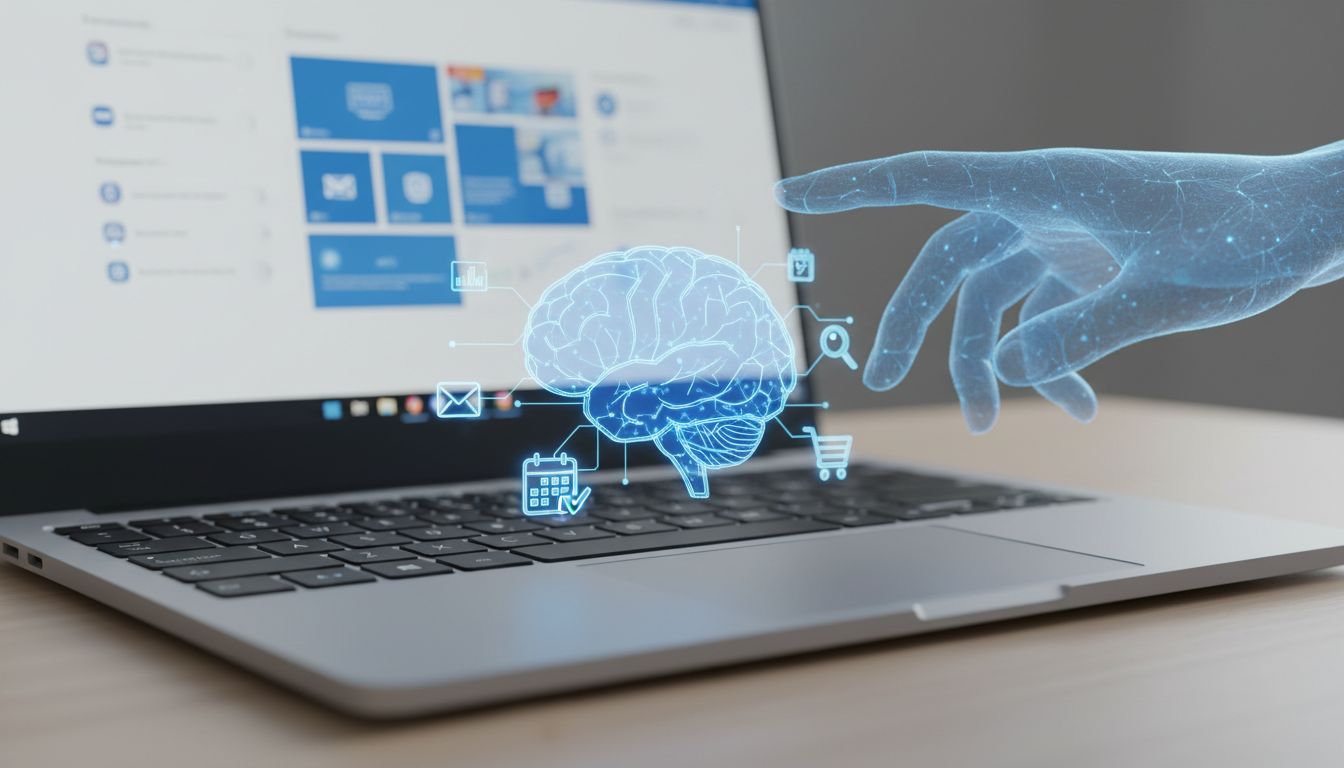

For years, most people experienced AI as something you asked for answers, summaries, or ideas. It could explain a process, draft an email, or suggest the next step, but the human still had to click the buttons, move between apps, and finish the job. That is starting to change. Today’s autonomous systems are increasingly built not just to talk about work, but to carry it out across real tools, workflows, browsers, and desktops.
This shift matters especially for everyday computer users, busy professionals, and small teams. The biggest value is no longer just “better chat.” It is less manual effort, fewer repetitive steps, and more tasks completed from start to finish. Across recent enterprise reports, vendor releases, and benchmark research, the direction is clear: the systems getting attention now are the ones that can plan, use tools, interact with software, and deliver measurable results safely.
From assistant to operator
One of the clearest signs of change is how the industry now talks about AI’s role. Gartner predicts that by the end of 2026, 40% of enterprise applications will include task-specific AI agents, up from less than 5% in 2025. That is a major jump, and it points to a world where AI is becoming part of the application layer itself rather than a separate helper sitting on the side.
In plain language, that means software is being redesigned to do more than support people with suggestions. It is being built to execute work autonomously inside business processes. Instead of answering “How do I do this?”, the system may gather information, open the right tools, complete the required steps, and return the finished outcome or ask for approval only when needed.
This is why the conversation has shifted so quickly. OpenAI’s Operator announcement described the change as moving AI from a passive tool to an active participant in the digital ecosystem, and that functionality was later folded into the broader ChatGPT agent experience. The message is simple: the next stage of useful AI is not only about smart responses. It is about taking action.
Why better chat is no longer enough
There was a period when improving chat quality felt like the whole story. Better writing, smoother conversations, and more natural answers were impressive, but they only solved part of the problem. If a user still has to copy information between tabs, update a spreadsheet, log into systems, and follow a ten-step process manually, the productivity gain is limited.
Microsoft has been especially direct on this point, saying customers are “putting the autonomous capabilities of an agent to work” to unlock business value. That emphasis is telling. The strongest signal is not that organizations want AI to sound smarter in a chat box. It is that they want it to execute production-style workflows with real business consequences.
This is also where many deployments still fall short. Reporting on Camunda research found that while 71% of organizations were using AI agents, only 11% of use cases had reached production in 2025. Four in five were still mainly using agents as chatbots or assistants, and nearly half said their systems worked in silos without full context. The gap between talking and doing is real, and the winners are crossing it.
What “doing the work” actually looks like
When people hear the term autonomous systems, they sometimes imagine science fiction. In practice, the most useful examples are much more grounded. These systems can read a request, break it into steps, look up information, interact with files or websites, use desktop controls, and move a task toward completion. The important difference is that the system is acting inside the workflow, not only describing it.
OpenAI’s March 2025 release made that direction very explicit. The company introduced the Responses API, built-in tools for web, file, and computer interaction, plus an Agents SDK for orchestrating single- and multi-agent workflows. That is infrastructure for action loops, tool use, and monitoring. It reflects a market where real value depends on execution, not standalone text generation.
We can see the same trend elsewhere. Google DeepMind’s Project Mariner showed the browser becoming a work surface for agents that can navigate and act across websites. Anthropic’s computer-use tooling documentation describes an explicit agent loop for calling the API and executing computer-use tools. Together, these developments show that browser and desktop autonomy are no longer abstract ideas. They are engineering targets.
Real value shows up in completed tasks
The strongest proof that autonomous systems matter is not a polished demo. It is a finished task, a saved hour, or a measurable business result. OpenAI’s 2025 enterprise report found that 75% of workers reported being able to complete tasks they previously could not perform, including programming support, spreadsheet analysis, troubleshooting, automation, and custom agent design. That suggests the frontier has moved beyond faster writing into actual capability expansion.
Microsoft also reported a concrete business impact from a deployed agent: its marketing team saw a 21.5% increase in conversion rate on Azure.com with a custom agent designed to assist buyers. That kind of KPI matters because it ties AI to execution and outcomes, not just user impressions about whether a conversation felt helpful.
Research from Dynatrace supports the same pattern. In its 2026 Pulse of Agentic AI, 50% of organizations said they had agentic AI in production for limited use cases, 44% had broad adoption across select departments, and 23% had mature enterprise-wide integration. Deployment is uneven, but it is real. These systems are already being trusted with work in specific environments.
Where autonomous systems are delivering ROI first
Not every business process is equally ready for autonomy. The earliest returns tend to appear where systems can observe operational data, make bounded decisions, and take repeatable actions. According to Dynatrace, leaders expected the greatest ROI for agentic AI in IT operations and system monitoring (44%), cybersecurity (27%), and data processing and reporting (25%).
That pattern makes sense. These are domains where a system can monitor signals, detect anomalies, trigger responses, prepare reports, and escalate exceptions. In other words, they are action-oriented environments. The AI is valuable because it can see, decide, and intervene within a workflow instead of stopping at explanation.
Even security research reflects this trend. The 2025 AIRTBench paper evaluated models on autonomously discovering and exploiting AI and machine learning vulnerabilities, with top systems solving a meaningful share of challenges. Whether for defense or offense, the important point is the same: these systems are increasingly being measured by what they can accomplish, not just what they can describe.
How the market is separating real systems from “agent washing”
As interest has grown, so has confusion. Many products now claim to be agentic, but not all of them truly perform autonomous work. Gartner said only about 130 vendors out of the thousands claiming agentic AI were delivering real autonomous capabilities, according to reporting based on its 2025 research. That tells us the market is actively separating substance from branding.
The difference usually comes down to whether a system can plan, use tools, maintain context, and execute reliably across multiple steps. A chatbot with a new label may still leave all the real work to the user. A genuine autonomous system can operate inside a process and make progress toward an outcome with limited supervision.
That distinction matters for buyers. As one 2026 report from Nylas put it, teams are looking for systems they can “actually trust to run inside real workflows, not just demo well.” For non-technical users and small teams, that is the practical test too. If the system cannot reliably complete the boring, repetitive, time-consuming parts of work, then it is still mostly talking.
Trust, governance, and human judgment now matter more
Once systems can act, safety stops being a side topic. It becomes central. Dynatrace quoted its chief technology strategist saying organizations are not slowing adoption because they doubt AI’s value, but because scaling autonomous systems safely requires confidence that those systems will behave reliably and as intended in real-world conditions. That concern exists precisely because these systems are now capable of meaningful action.
Recent reporting has also highlighted the governance challenge, citing analyst expectations that 40% of enterprise applications will include AI agents by the end of 2026 and research claiming that 47% of AI agents are running without oversight. Even if individual estimates vary, the broader message is clear: ungoverned action-capable systems create operational risk in a way that chat-only tools generally do not.
This is why Microsoft’s recent Copilot Studio updates emphasized combining “autonomous workflows with human judgment.” In practice, that means building systems that can execute multi-step work while still routing approvals, escalating edge cases, and keeping humans in control where it matters most. The goal is not to replace judgment entirely. The goal is to remove friction without losing accountability.
Production readiness is now about observability, standards, and evaluation
If autonomous systems are going to do real work, they need to be monitored like real systems. Prompting alone is not enough. OpenAI’s 2025 agent tooling stressed tracing and evaluations for monitoring performance over time, which is a strong sign that production readiness now depends on observability and testing, not just clever instructions.
Standards are emerging for the same reason. OpenAI says that since August 2025, AGENTS.md has been adopted by more than 60,000 open-source projects and agent frameworks, including tools such as Codex, Cursor, Devin, Gemini CLI, GitHub Copilot, Jules, and VS Code. That level of adoption is a concrete sign that autonomous systems are becoming operational infrastructure rather than one-off demos.
The research community is evolving in parallel. The January 2026 paper AgencyBench evaluates 138 tasks across 32 real-world scenarios and six core agentic capabilities, arguing that autonomous agents can contribute substantially to economic production. A dedicated AI Agent Index now tracks deployed systems and their technical and safety features. These are not the signs of a field focused only on text quality. They are the signs of a field measuring execution.
For everyday users, all of this points to a simpler truth. The most valuable AI is becoming less like a clever person giving instructions from the sidelines and more like a capable teammate that can help carry the load. That does not mean fully hands-off automation in every situation. It means more software that can see what is on your screen, understand the task, guide you when needed, and take care of the repetitive parts that slow you down.
That is why today’s autonomous systems do the work, not just the talking. The market is rewarding planning, tool use, workflow orchestration, browser and desktop control, monitoring, and measurable outcomes. For individuals and teams trying to save time and reduce frustration, that is the shift that matters most: AI is becoming useful not only because it can say smart things, but because it can help get real work done safely and repeatedly.