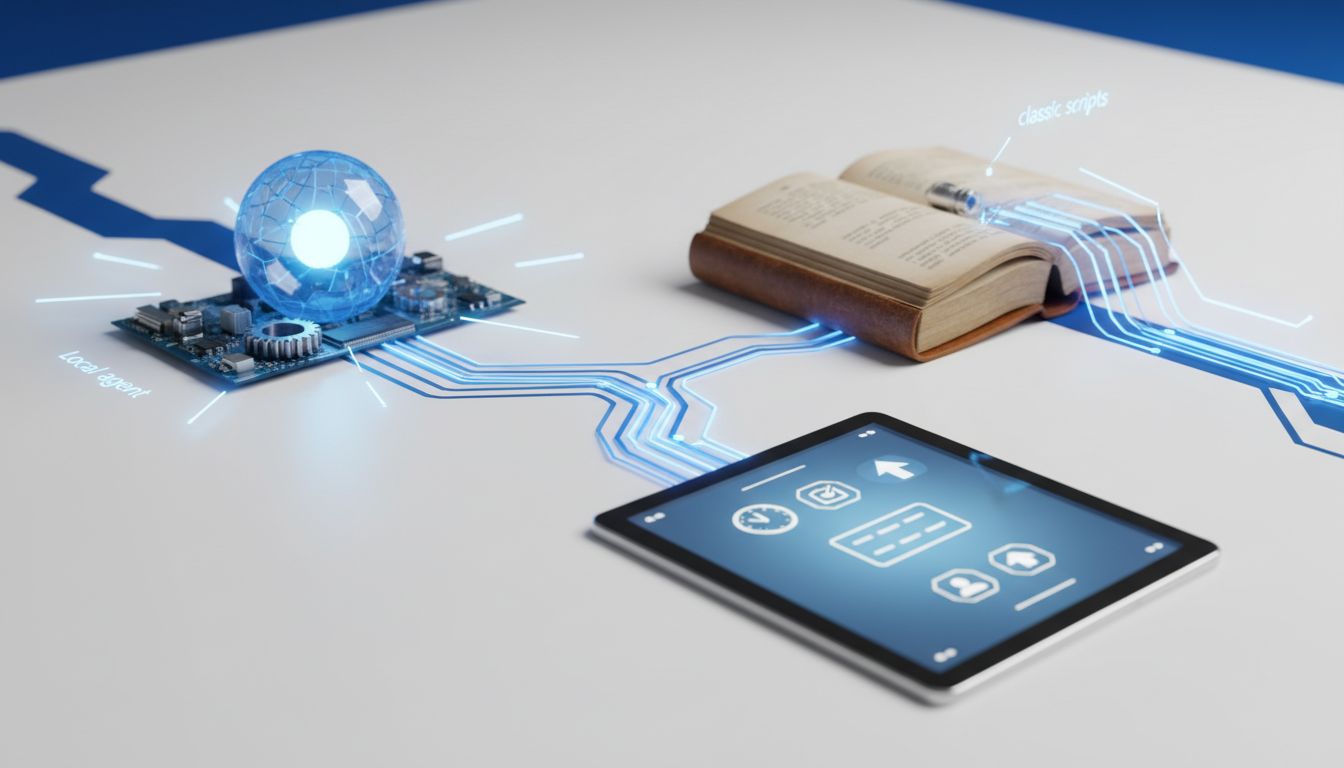

For years, most AI tools were judged by how well they could answer questions. That was a useful starting point, but work rarely stops at an answer. Real tasks usually involve opening apps, checking what is on screen, following steps, moving information between tools, and completing a sequence of actions without losing time or context. That is why the conversation is shifting from AI that talks to AI that helps get things done.
At the same time, privacy expectations are rising just as quickly as productivity expectations. People want AI that is helpful, fast, and practical, but they do not want every sensitive detail of their work sent to the cloud whenever they ask for help. This is where proactive on-device agents are starting to stand out: they can guide, automate, and act closer to the user, reducing friction while also reducing exposure.
Why the market is moving from answers to actions
The biggest change in AI at work is not just better writing or smarter search. It is the move into repeatable, multi-step workflows. OpenAI’s enterprise report says organizations are increasingly using AI across functions and business units in structured workflows, which supports a broader shift from “give me an answer” to “help me complete the task.” For everyday users, that means AI is becoming less like a search box and more like a capable teammate.
This change matters because many work tasks are full of small interruptions. You read an email, open a spreadsheet, copy information into a form, switch to chat, check a dashboard, and then come back to finish the original task. A proactive agent can reduce that stop-and-start pattern by helping across steps instead of handling only one prompt at a time. That is where the real productivity value starts to show up.
The language of the industry reflects this shift. Recent enterprise materials and analyst reports increasingly use the word “agent” instead of “assistant.” That is not just branding. It signals a higher expectation: not merely generating text, but executing workflow steps, coordinating tools, and helping users move from intent to completion.
Measured productivity is making the case real
One reason agents are gaining momentum is that the benefits are no longer described only in vague, futuristic terms. OpenAI reports that surveyed workers attribute 40 to 60 minutes of time saved per active day to ChatGPT Enterprise use. In data science, engineering, and communications roles, reported savings rise to 60 to 80 minutes per day. Those are meaningful numbers for busy professionals and small teams trying to do more with limited time.
What makes these findings especially important is that they suggest AI value is becoming operational, not experimental. Saving even 40 minutes a day can mean fewer backlog items, faster responses, less context switching, and more room for focused work. For non-technical users, the promise is not “transform your business overnight.” It is simpler and more believable: finish routine work faster and with less frustration.
OpenAI also says 75% of surveyed workers reported AI helped them improve speed or quality, and 75% said it helped them complete new tasks. That second number matters a lot. It suggests AI is not only accelerating familiar work, but also helping people take on tasks they may have previously delayed, outsourced, or avoided altogether.
Usage patterns show AI is becoming part of real workflows
Growing adoption is one thing. Deepening usage is another. OpenAI says weekly Enterprise messages grew about 8x year-over-year, while average workers are sending 30% more messages. That points to AI becoming more embedded in day-to-day work rather than being used as a novelty or occasional helper.
The enterprise scale is already large enough to matter. OpenAI says it now serves more than 7 million ChatGPT workplace seats, and ChatGPT Enterprise seats have grown approximately 9x year-over-year. These are not small pilot numbers anymore. They suggest that businesses are investing in AI tools because employees are finding practical value in them.
There is also evidence that AI’s biggest value may come from augmenting specialized work rather than replacing it. OpenAI reports that more advanced features correlate with more time saved, and workers saving more than 10 hours per week tend to use multiple models, more tools, and a wider range of tasks. In other words, the more AI fits into real workflows, the more useful it becomes. That creates a natural path toward proactive agents that can support complex, multi-step work.
Why proactive agents matter more than passive assistants
A passive assistant waits for a prompt, gives a response, and stops. A proactive agent does more. It can notice what task you are working on, suggest the next step, help you navigate an app, and automate repetitive actions before the work stalls. For knowledge workers and small teams, this can reduce mental over in a very practical way.
One of the biggest benefits is reduced tool-switching. OpenAI’s enterprise report describes AI being embedded in multi-step workflows across functions, and that is the foundation for proactive behavior. When AI can stay close to the workflow instead of living in a separate chat tab, users spend less time bouncing between windows and more time actually completing tasks.
This does not mean people want fully autonomous software making every decision. In most workplaces, users still want to stay in control. The winning model is increasingly “agentic but bounded”: AI that can guide and automate within clear limits, ask for confirmation when needed, and keep the human informed. That approach feels more trustworthy and more useful for everyday work.
Why on-device AI is becoming a privacy feature
On-device AI used to be discussed mostly as a speed or performance optimization. Now it is becoming a privacy feature in its own right. Apple says Apple Intelligence uses on-device processing for many tasks, and when larger models are needed, Private Cloud Compute is designed so user data is not stored or shared with Apple and is used only to fulfill the request. That framing is important because it treats privacy as part of the product experience, not as a footnote.
Apple is also explicitly positioning on-device AI as an offline-capable developer platform. Its Foundation Models framework lets developers build experiences that work when users are offline while protecting privacy. That sends a strong signal that local-first AI is becoming a mainstream product strategy rather than a niche technical preference.
For users, the value is easy to understand. If more reasoning and action happen on your device, less sensitive context needs to leave your device. That can include what is on your screen, the files you are working with, the websites you have open, and the sequence of actions that make up a task. Keeping more of that local reduces exposure and gives people more confidence using AI for real work.
Attack-surface reduction is the real privacy advantage
The strongest privacy argument for on-device agents is not just “your data feels closer.” It is attack-surface reduction. When less sensitive context is transmitted externally, there are fewer places where that data can be intercepted, mishandled, retained unnecessarily, or combined with other systems. This directly addresses one of the biggest concerns around agentic AI: trust.
Gartner reported that 75% of surveyed IT application leaders were piloting, deploying, or had already deployed some form of AI agents, but only 15% were considering, piloting, or deploying fully autonomous AI agents. That gap says a lot. Interest is high, but confidence is not. Organizations see the opportunity, yet they remain cautious about giving AI broad autonomy in cloud-connected environments.
Governance and security are a major reason why. Gartner found only 19% of respondents had high or complete trust in vendors’ hallucination protection, while 74% believed AI agents represent a new attack vector. On-device agents help here because they can keep more context, reasoning, and action local. They do not solve every risk, but they can reduce the amount of sensitive information exposed across networks and external services.
Private by default is becoming a competitive advantage
A clear market narrative is forming around AI that is private by default. Apple’s on-device approach, Microsoft’s privacy framing, and Gartner’s governance findings all point in the same direction. As organizations become more serious about deploying agents, they also become more serious about minimizing unnecessary data movement. Products that can deliver useful automation while exposing less information will have an advantage.
Microsoft’s 2025 Privacy Report says it is focused on driving AI innovation while protecting privacy, and highlights capabilities meant to improve security, safety, and privacy of AI systems. That language matters because it shows privacy messaging is no longer separate from AI deployment strategy. It is now part of how vendors explain why their AI should be trusted in daily work.
OpenAI’s privacy-preserving analytics language also reflects this broader shift. The company says its signals and enterprise analyses are based on privacy-preserving, de-identified, aggregated data. That is another sign of a market trying to prove AI value without exposing user content. In practice, proactive on-device agents fit this direction well because they are aligned with a simple promise: help more, expose less.
Local-first agents can also lower access friction
Privacy is not the only reason on-device agents are gaining ground. Access matters too. Microsoft’s 2025 AI Diffusion Report says global adoption rose in the second half of 2025 and that roughly one in six people worldwide now uses generative AI tools. That is impressive growth, but the report also notes adoption is uneven across regions and contexts.
That unevenness matters because cloud-first AI depends heavily on reliable connectivity, device compatibility, and service availability. Microsoft frames adoption as shaped by OS and device market share, internet penetration, and population differences. In that environment, device-native AI can reduce friction by making useful features available with less dependence on constant cloud access.
This is one reason Apple’s offline-capable developer platform is so significant. If AI can guide tasks and automate actions even when connectivity is limited, it becomes more dependable in everyday situations. For users, that means fewer interruptions and a smoother experience. For teams, it means AI can support work where and when it happens, not only when the internet and cloud permissions align perfectly.
What winning agent experiences will look like
The most successful agents will likely not be the ones that promise total autonomy. They will be the ones that are helpful, visible, and bounded. They will understand what is happening on screen, suggest the next step, automate repetitive parts of a task, and ask before taking sensitive actions. That balance gives users speed without making them feel out of control.
They will also be designed around real desktop work, not idealized demos. That means helping with forms, spreadsheets, browser tasks, internal tools, customer follow-ups, scheduling, documentation, and all the little actions that eat up a workday. When AI can operate inside those routine flows, the productivity gains become tangible in the same way recent enterprise numbers already suggest: in minutes saved, errors avoided, and frustration reduced.
Most importantly, winning agents will combine action with restraint. They will be proactive enough to reduce busywork, but private enough to earn trust. In a market where productivity gains are increasingly measurable and security concerns are still unresolved, that combination is powerful. It is why proactive on-device agents are not just a new feature category. They are quickly becoming the practical shape of AI that people are willing to use every day.
The case for proactive on-device agents is strong because it brings together three trends that are all moving at once: measurable productivity gains, rising enterprise adoption, and persistent privacy and security concerns about cloud-mediated autonomy. Businesses clearly want AI that can do more than answer questions, but they also want approaches that fit real governance requirements and everyday user trust.
That is why the future of AI at work will likely belong to systems that turn intent into action while keeping people in control and sensitive context close to the device. For users, that means less switching, less waiting, and less friction. For organizations, it means a more realistic path to AI deployment: useful, proactive, and private by default.